
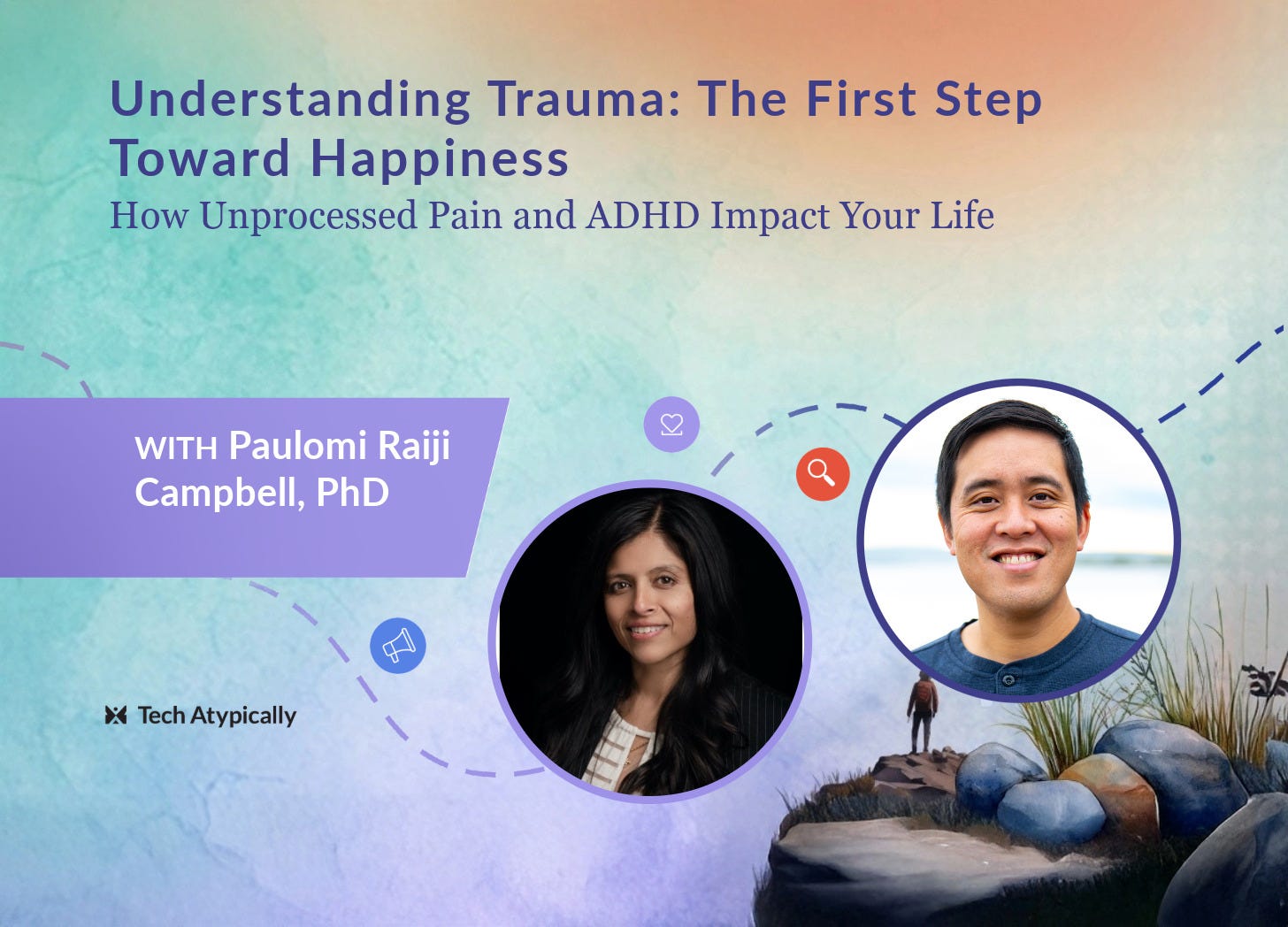
#99🌱 Understanding Trauma: The First Step Toward Happiness
How Unprocessed Pain and ADHD Impact Your Life


Welcome to Tech Atypically 👋, your weekly blog for navigating the challenges of ADHD and being in the tech industry.
I am an ADHD and product management coach, helping you change one belief and take one action each week.
🐼Do you work in Tech and are tired of struggling? Get ADHD and job skill coaching with Tech Atypically.
Part 13 of the Finding Happiness Series
🦋The Takeaways
Belief: My struggles are character flaws or simply "in my head."
Reality: Many challenges stem from unprocessed trauma that your body and mind are trying to communicate.
Action: Begin healing by validating your experiences and practicing unconditional self-love.
⭐️Introduction
One of the most common topics in my ADHD coaching practice that comes up is trauma. The experience of things is so bad, we can’t fully cope with the experience.
Many of us with ADHD are carrying unresolved trauma that complicates our lives. I realized that if I wanted to learn to practice more happiness, I would have to learn to better confront the trauma that has shaped my beliefs.
Recently, I had the chance to speak with Dr. Paulomi Raiji Campbell, a chronic pain specialist at Swedish Medical Center.
Many of us dismiss our painful experiences as "not that bad" or "just the way things were." We might even believe we should "walk it off" or "just get over it," especially if we grew up in families where emotions weren't openly discussed (where my fellow south Asians and southeast Asians at?)
Today, I want to share what I've learned about the basics of trauma and how recognizing it can be the first step toward learning how to learning to accept yourself and eventually find happiness.
😵💫The Belief - It's Just In My Head
For years, I believed that my tendency toward self-loathing was simply a character flaw or a side effect of my ADHD. I thought my feelings of not being good enough were my personal failings. Everyone felt great about themselves. I was a constant failure.
Growing up in an Asian household, I received a clear message: my worth was tied to my output and outcomes. I existed in a binary state—either I was benefiting the family, or I was a burden. There was no in-between. I either got good grades or made money, or I was a failure.
When I was diagnosed with ADHD as an adult, I initially focused on the "disorder" part—another thing that made me defective. I grieved the life I might have had if I'd been diagnosed earlier, blaming myself for not having “fixing” myself sooner.
I never considered that what I experienced might be trauma. After all, I hadn't lived through war or abuse—the "big T" traumas we often associate with the word. Surely, my experiences weren't significant enough to count.
This belief kept me from addressing the real source of my pain and made me focus on "fixing" myself instead of healing.
🤝The Reality - Your Body Is Trying to Tell You Something
"Anxiety, depression, chronic pain—it's all your body desperately trying to tell you that I'm lost," Dr. Raiji Campbell explained to me. "I don't know what to do with all that happened to us."
Trauma isn't just the big, catastrophic events (what therapists call "big T" trauma). It also includes the less obvious "little t" traumas—ongoing situations where you felt helpless, unsupported, or alone.
As Dr. Raiji Campbell points out, "As children we are wired to need unconditional love from our caretakers. So when that isn't there, that's a trauma."
For those of us with ADHD, this is particularly significant. Our struggles with emotional regulation, rejection sensitivity, and self-perception aren't just symptoms of a disorder—they're often compounded by the trauma of growing up different in a world that demanded conformity.
The reality is that trauma affects our nervous system. It gets stored in our bodies when we don't have the resources to process difficult experiences. For me, the conditional love I received as a child created a deeply ingrained belief that I was fundamentally flawed—a belief that my ADHD diagnosis initially seemed to confirm rather than explain.
Understanding that these reactions are not character flaws but responses to trauma can be the first step toward healing. Your body isn't betraying you—it's trying to communicate something important.

🛠️The Action - Begin With Validation and Self-Love
Healing from trauma, especially when combined with ADHD, begins with these fundamental steps:
1. Validate Your Experience
"Just recognizing that and having compassion for yourself is the first step," Dr. Raiji Campbell advises, "validating that your experience was traumatic helps your nervous system to settle.”
Name it: Call your experiences what they were—trauma
Release blame: This isn't about pointing fingers at others
Honor your feelings: Your emotional responses make sense given what you experienced
Be specific: "Growing up with conditional love was traumatic for me"
2. Practice Unconditional Self-Love
This is particularly challenging for those of us who never received it.
Notice performance patterns: When do you feel you need to achieve to be worthy?
Enlist allies: Ask trusted friends to point out when you're being too hard on yourself
Separate worth from output: Remind yourself "I am enough, even when I produce nothing"
Use affirmations: Simple statements like "I accept myself as I am right now"
3. Get to Know Your Authentic Self
Many of us with childhood trauma and ADHD struggle to know what we truly want or need.
Physical preferences: What foods, sleep patterns, and activities make you feel good?
Core values: What principles matter most to you? (Family? Honesty? Adventure?)
Personal boundaries: What are your limits with yourself and others?
Small choices: Practice making decisions based on what you want, not what others expect
4. Connect With Your Body Through Breathing
Find a breathing technique that works for your unique nervous system.
Try diaphragmatic breathing: Place your hand on your abdomen and feel it rise and fall
Experiment with box breathing: Inhale for 4, hold for 4, exhale for 4, hold for 4
Use visualization: Imagine breathing in colors that flow through your body
Start small: Even 30 seconds of intentional breathing can help regulate your system
✨Conclusion
Understanding trauma isn't about assigning blame or dwelling in the past—it's about recognizing how past experiences shape our present responses so we can begin to heal.
For those of us with ADHD, recognizing the intersection of neurodivergence and trauma can be particularly powerful. Many of the patterns we attribute solely to our ADHD may be amplified by unresolved trauma.
The path to happiness often begins with acknowledging our wounds. By validating our experiences and practicing unconditional self-love, we can begin to rewrite the stories we tell ourselves—not as broken people who need fixing, but as whole humans worthy of compassion and understanding.
I get it. I helped write this article. But it’s still hard. I think it’ll always be hard for me to accept who I am and my experiences. I’m gonna try anyway, though. I hope you can join me.
⏭️Next Week
Celebrating my 100th topic post with a letter to myself.
 | A guest post by
|